
Chatbots in 2026: the FAQ menu is history
Forget everything you think you know about chatbots.
The typical chatbot of 2022 was essentially a glorified FAQ menu. Click here, click there, and maybe a half-decent answer turned up. If not, you were referred to support, and that was that.
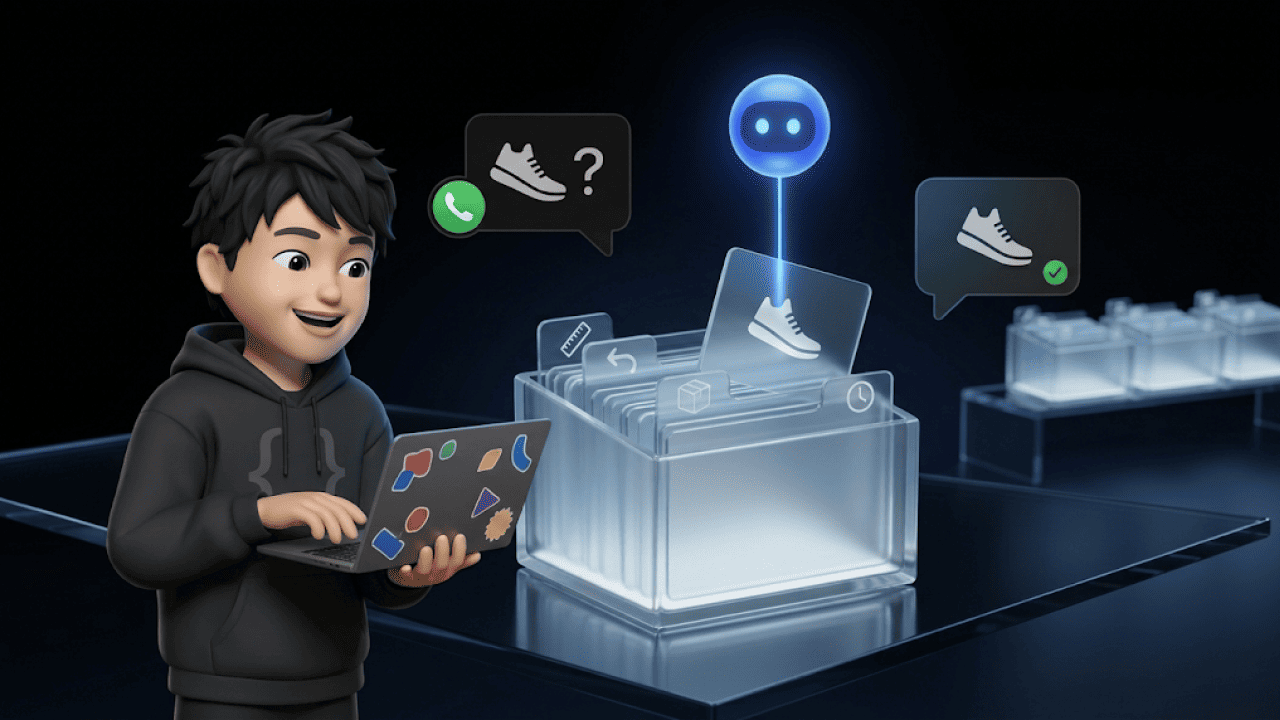
In 2026 the reality looks different. Modern chatbot providers rely on AI-powered systems that answer questions and carry out actions on their own. A concrete example: a customer writes on WhatsApp, "I want to return my order." A classic chatbot would have sent them to the FAQ page. A modern AI bot pulls the order data from Shopify and creates the returns label via the logistics API. The PDF lands straight in the chat, with no human involvement.
We explain the terms for this, AI agent and agentic AI, in detail in our article AI agents vs. chatbots. For this comparison one clear distinction is enough: the chatbot answers. The AI acts. Choose a provider that can act.
The shift is measurable. According to our AI customer service benchmark of 131 shops and 2.9 million tickets, one in three support tickets is already automated today. Gartner expects AI agents to resolve around 80% of common customer service issues without human intervention by 2029 (Gartner, March 2025).
How to choose the right chatbot provider in 2026
The criteria for a good chatbot provider have shifted. Today every provider has AI. What matters is which AI works on which data, how deeply it is integrated into your tech stack and what it costs.
RAG instead of free-form hallucination
RAG stands for retrieval-augmented generation. It sounds technical, but it simply means that the bot draws on your company data, such as your product catalogue, FAQ database and shipping information, instead of piecing answers together from a language model's general training.
Why this matters: a chatbot based on general GPT knowledge is very likely to invent shipping costs that do not exist or recommend products you do not stock. RAG prevents exactly that by having the bot rely only on verified information from your knowledge base.
Depth of integration, not a list of integrations
Many chatbot providers advertise long lists of integrations. The decisive question is: "Can the bot create a return in Shopify, check the order status in real time and communicate in a personalised way based on Klaviyo segments?"
For e-commerce companies, these integrations are a must in 2026:
Shop system (Shopify, Shopware, WooCommerce): read AND write order data
Marketing automation (Klaviyo, Emarsys): segmentation and personalised messaging
Ticketing (Zendesk, Gorgias, Freshdesk): a clean handover to human support when the bot gets stuck
Our guide to the WhatsApp Business API explains how the type of API connection affects your setup.
GDPR and server location
In the DACH region, data protection is mandatory. Anyone who processes personal customer data through a chatbot needs a sound GDPR basis, and that applies to everyone who stores order data, email addresses or chat histories.
In concrete terms, this means servers in the EU, a data processing agreement (DPA) and transparent data processing. With US providers, check carefully whether EU hosting is included in the plan you choose.
Channel coverage: WhatsApp first
WhatsApp is the channel with the highest attention in DACH e-commerce. According to our open rate benchmark, a good WhatsApp open rate is 72% as the median per brand.
A chatbot provider that does not offer a fully featured WhatsApp channel in 2026, meaning chat, newsletters, flows and campaigns, has a structural problem.
Human handover
No AI bot in the world resolves 100% of enquiries. According to our customer service automation benchmark, the top 25% of shops automate 61.2% of their support tickets on average. What matters is what happens to the rest.
A clean human handover means that the human agent sees the entire chat history, knows the data already collected and does not have to ask the customer to repeat their request. AI for standard questions and human empathy for complex cases are the gold standard.
Time to value: how quickly is your bot ready?
This criterion is missing from many comparisons, yet it costs real money. Setup time varies widely between providers.
Modern chatbot platforms crawl your website and knowledge base and are often ready to use within a few days. You upload your data sources, configure the flows, and the bot is live.
Enterprise contact centre platforms such as NiCE Cognigy or Parloa handle pricing and implementation through their sales teams. Plan more time for the project and coordination there, and ask for a realistic timeline in advance.
Pricing transparency: what to watch out for with pay-per-resolution
Some chatbot providers charge per resolved enquiry. It sounds fair: you only pay when the bot actually resolves an enquiry. According to its own pricing page, Intercom charges $0.99 per "outcome" for its Fin AI Agent, with a minimum of 50 outcomes per month (as of 5 November 2026).
Work this out for your own volume: at 2,000 resolved enquiries a month, that is $1,980 on top of your licence costs. At 5,000 resolved enquiries, it is $4,950. The more your bot resolves, the higher the bill. It can still pay off if each resolved enquiry saves more than it costs.
When choosing a provider, check whether the pricing model is based on fixed fees, conversation packages or resolution pricing, and ask for a projection based on your volume. At Chatarmin, you receive an individual quote for your setup after the demo.
Chatbot providers 2026: quick comparison
Before you dive into the details of each provider, here is an overview at a glance:
| Criterion | Chatarmin | Intercom | moinAI | Lime Connect | NiCE Cognigy | Tidio | ManyChat |
|---|---|---|---|---|---|---|---|
| Focus | WhatsApp commerce + support | Helpdesk + AI agent | Website chat AI | Unified messaging | Enterprise voice + chat | SMB live chat | Social media automation |
| AI agent | ✅ | ✅ (Fin) | ✅ | ✅ (add-on) | ✅ | ✅ (Lyro, add-on) | ✅ (add-on) |
| WhatsApp as a channel | ✅ | ✅ | ✅ (on request) | ✅ | ✅ | ✅ | ✅ |
| WhatsApp campaigns | ✅ Newsletters, flows | ✅ | – | ✅ Add-on from €20/month + Meta fee | – | ❌ Replies only | ✅ |
| Voice/telephony | ✅ AI Voice | ✅ Fin Voice (selected customers) | – | – | ✅ | – | – |
| Shopify | ✅ Read + actions | ✅ Read + actions | ✅ Read order status | Widget embed | – | ✅ Read + actions | Via Zapier/Make |
| EU hosting | ✅ Servers in Germany | ⚠️ From Advanced plan | ✅ Germany | ✅ Germany | – | ✅ EEA | ⚠️ Processing also in the USA |
| Starting price | Individual quote | From $29/seat + $0.99/outcome | From €750/month (annual) | Free, Pro from €87/month (annual) | On request | Free, from €24.17/month (annual) + add-ons | Free, Pro from $15/month |
"–" means: not shown in the provider's public documentation.
Prices and details according to the providers' websites, as of 5 November 2026. You will find the sources in each provider's section.
Chatbot providers compared: the most relevant solutions in 2026
Many providers call their product an "AI chatbot". We focus on the nine that are genuinely relevant for e-commerce and customer service in the DACH region. Fair and transparent, and yes, we start with ourselves.
Chatarmin: WhatsApp and AI for e-commerce in the DACH region
What Chatarmin does: Chatarmin combines WhatsApp marketing and AI-powered customer service in one platform. The idea: marketing and support belong together. If you send a customer a campaign on WhatsApp and they reply with a question, you need to be able to answer it in the same channel, and automatically. The customer service part comes from armincx by Chatarmin.
Strengths:
Deep shop integration: Real read and write access to order data, returns and customer data in Shopify, JTL, Xentral, Shopware and Billbee. On top of that come connections to Klaviyo, Gorgias and other systems.
WhatsApp as the core channel: Newsletters, flows, AI chatbot and human support run in one channel and one platform.
Data protection: Hosting in the EU, with servers in Germany. In addition, there is a DPA and EU standard contractual clauses.
AI actions: The AI agents answer questions and carry out actions: checking order status, cancelling orders, changing addresses and starting returns.
AI telephony: With AI Voice, Chatarmin also offers voice-based automation for companies that want to cover the phone channel as well as chat.
Omnichannel inbox: WhatsApp, email, Instagram, Facebook, live chat and contact forms in one inbox, with a ticketing system and workflow builder.
Who it is for: E-commerce companies with medium volume and above that want to use WhatsApp as a performance channel for marketing and support at the same time. 510+ brands use Chatarmin, including Marc O'Polo and waterdrop.
The Marc O'Polo case study shows how a premium brand uses WhatsApp for personal customer relationships.
Price: Individual quote after the demo. A shop with 5,000 orders a month has very different requirements from a company with 50,000, which is why there are no standard packages.
Limitations: If you only need a simple website chat without automation and without WhatsApp, low-cost entry tools such as Tidio or Smartsupp are often the better fit. Chatarmin is built for companies that see WhatsApp as their central communication channel and, with AI Voice, now also factor in the phone channel.
Intercom: global player with usage-based AI
What Intercom does: A US customer service platform with live chat, helpdesk, a messenger widget and the AI bot "Fin AI Agent", which resolves customer enquiries automatically.
Strengths:
- Mature helpdesk system with ticketing, inbox and reporting
- According to Intercom, Fin AI Agent resolves 76% of enquiries on average across more than 12,000 customers (fin.ai)
- Multichannel: website chat, email and WhatsApp, including outbound WhatsApp campaigns (Intercom)
- Large integration ecosystem
- Copilot feature for human agents
Who it is for: Internationally oriented companies that already use Intercom and want to add the AI bot.
Price according to Intercom, as of 5 November 2026: With annual billing, Essential costs $29 per seat per month (currently $19 for new customers), Advanced $85 and Expert $132. With monthly billing, it is $39, $99 and $139. On top of that comes Fin AI at $0.99 per outcome, with a minimum of 50 outcomes per month. Example: at 3,000 automatically resolved enquiries a month, you pay $2,970 for the AI, in addition to the licence fees.
Limitations: The usage-based model makes costs harder to plan as volume grows. According to Intercom, EU hosting in Ireland is only available for new workspaces on the Advanced and Expert plans. Fin Voice for phone calls is currently only available to selected customers via sales.
moinAI: AI chatbot from Hamburg
What moinAI does: A conversational AI platform from knowhere GmbH in Hamburg, focused on automated customer communication, primarily in website chat.
Strengths:
- Its own AI features such as "Dreaming", which automatically analyses every chatbot conversation, and "Reassuring" for better language understanding (moinAI)
- Strong intent recognition that also handles unstructured input well
- RAG approach: the knowledge base can be filled via URLs and documents
- Hosting on servers in Germany according to the moinAI Help Centre
- According to its own website, used by more than 170 companies, including ImmoScout24
Who it is for: German mid-sized companies that want to automate their website chat and value German-speaking support.
Price according to moinAI, as of 5 November 2026: Business from €750 per month with annual billing or from €880 with monthly billing. Growth from €1,350 or €1,580 respectively, Professional from €2,500 or €2,930. The minimum term is 3, 6 or 12 months, depending on the plan.
Limitations: The platform is aimed primarily at website chat and support use cases. Conversational commerce and sales are less of a focus.
Lime Connect (formerly Userlike): unified messaging with roots in Germany
What Lime Connect does: A platform for AI-powered support automation and customer messaging across several channels. According to its own website, it has more than 15 years of market experience.
Strengths:
- ISO 27001 certified and, according to the company, hosted in Germany (Lime Connect)
- AI agent for autonomous answers plus Copilot as an assistant for human agents
- Website chat, WhatsApp and other messaging channels in one platform
- WhatsApp campaigns for proactive messages and newsletters, available according to the pricing page as an add-on from €20 per month plus Meta fees
- Customers such as Toyota and Hermes, both according to the provider's website
Who it is for: Companies of any size looking for an all-in-one solution for website chat and messaging. Particularly strong in classic customer service.
Price according to Lime Connect, as of 5 November 2026: Free plan with 1 seat and 200 conversations. Pro from €87 per month with annual billing or €105 with monthly billing, excluding VAT and with a minimum of 3 seats. The AI Agent add-on costs from €99 per month for 100 conversations.
Limitations: The focus is on customer service and messaging, less on e-commerce-specific use cases such as abandoned cart automation or product-based upselling logic. The AI agent and workflows cost extra as add-ons.
For a more detailed comparison of the cost components, take a look at WhatsApp Business costs.
NiCE Cognigy: enterprise voice and chat
What Cognigy does: An enterprise platform for conversational automation with a flow editor and a clear strength in voice and telephony. Cognigy has headquarters in Düsseldorf and Dallas and has been part of NiCE since September 2025 (Cognigy).
Strengths:
- According to the provider, more than 100 languages out of the box
- Voice bots for phone support: Cognigy combines text-based and voice-based bots in one platform. For companies with a high volume of phone calls in customer service, this is a relevant differentiator.
- Strong orchestration and handover system for complex corporate structures
- Flow-based editor for human-like conversation flows
Who it is for: Large companies and corporations with complex, multilingual requirements that want to manage text and phone bots from one platform.
Price: No public prices, quote via sales.
Limitations: For the typical mid-sized e-commerce business, the platform is usually oversized. Plan time and internal IT resources for implementation.
Parloa: AI agents for contact centres
What Parloa does: An AI platform from Berlin that describes itself as a platform for managing AI agents in enterprise customer service, for voice and chat (Parloa). Its focus is the classic contact centre market with a high volume of phone calls.
Strengths:
- Strong positioning in voice AI with natural-sounding phone bots
- AI agents for voice and chat from one platform
- Strong positioning in the German-speaking enterprise segment
- Integration with existing contact centre infrastructure such as Genesys Cloud
Who it is for: Companies with a large volume of phone service (insurance, telecommunications, utilities) that want to automate their phone support.
Price according to Parloa: Usage-based, per minute for voice and per interaction for chat. Specific prices only on request.
Limitations: Parloa is aimed at large contact centres. For e-commerce companies that mainly want to combine WhatsApp marketing and support, there are better-suited solutions.
Tidio: entry-level solution for small shops
What Tidio does: A customer communication platform that combines live chat, an AI chatbot (Lyro) and a helpdesk, primarily for small and medium-sized businesses.
Strengths:
- Very easy setup, even without technical knowledge
- Visual drag-and-drop flow builder
- Shopify integration that lets your team cancel orders, issue refunds and change addresses (Tidio)
- Lyro AI Agent answers questions based on your own knowledge base
- Data storage on servers in the European Economic Area according to Tidio
Who it is for: Small online shops looking for a quick start in chatbot automation on a limited budget.
Price according to Tidio, as of 5 November 2026: Free with 50 conversations per month, Starter from €24.17 per month with annual billing (€29 monthly), Growth from €49.17 (€59 monthly). The AI features come as add-ons: Lyro and Flows cost extra depending on volume, and the cost calculator on the pricing page shows the price.
Limitations: The add-on structure and billing by conversation make costs harder to calculate as volume grows. Check in advance whether there are connections to DACH systems such as JTL or Xentral.
ManyChat: social media automation
What ManyChat does: A chatbot builder with a strong focus on Instagram, Facebook Messenger and WhatsApp, primarily for marketing automation and lead generation.
Strengths:
- Very strong Instagram and Facebook automation (comment-to-DM, story replies)
- Easy to start: free plan up to 1,000 contacts
- Visual flow builder, also for non-technical users
- Large community and plenty of learning material
Who it is for: Creators, small D2C brands and social-media-driven companies that want to monetise their Instagram and Facebook audience.
Price according to ManyChat, as of 5 November 2026: Free up to 1,000 contacts, Pro from $15 per month, depending on the size of your contact list. Using WhatsApp incurs additional Meta fees.
Limitations: The provider is the US company Manychat, Inc., and according to its privacy policy personal data may also be processed in the USA. Check the GDPR basis before using it. ManyChat is not built for extensive customer service automation with ticketing.
Our WhatsApp marketing software comparison gives a more detailed view of which tools suit marketing versus pure support.
Brevo (formerly Sendinblue): all-in-one marketing suite
What Brevo does: A marketing platform from Paris that bundles email, SMS, WhatsApp, CRM and chat in one suite.
Strengths:
- Everything from one source: email marketing, CRM, transactional emails and live chat
- WhatsApp campaigns with images and videos (Brevo)
- Its own marketing automation engine
- European company based in Paris
Who it is for: Companies looking for a single platform for all marketing channels that do not need a specialised chatbot provider.
Price according to Brevo, as of 5 November 2026: Free plan available, Starter from €7 per month and Standard from €15 per month with monthly billing. Annual billing comes with a 10% discount.
Limitations: Jack of all trades, master of none. Chat is one feature among many and is not at the core of the platform. For complex support automation or agent-based workflows, you are better served by specialised providers.
From cost centre to profit centre: why your chatbot must generate revenue in 2026
The biggest mistake when choosing a chatbot provider: you plan it as a cost centre.
"How much can we save on support?" was the question of 2023. The question in 2026 is: how much revenue does the bot generate?
Recover abandoned carts
According to the Baymard Institute, customers abandon around 70% of all shopping carts in e-commerce. An AI bot that answers a delivery time question on WhatsApp prevents drop-offs and closes sales. According to our flows benchmark, an abandoned cart contact via WhatsApp brings in €9.65 in revenue on average.
Automate product advice
"Which size fits me?" "Is this product suitable for sensitive skin?" "What goes with my previous purchase?" A trained AI bot answers these questions in seconds, without waiting time and without a support ticket, right in the chat and straight to checkout.
WhatsApp as a revenue channel
Chatarmin connects marketing and support in one system. Through the same channel, you send your WhatsApp newsletter and your AI bot answers follow-up questions. That way it guides the customer straight to the purchase.
The Gloria Skincare case study shows how powerful this channel can be: within five months, the brand went from zero to more than €100,000 in WhatsApp revenue per month. Once you understand this connection, you also understand why a specialised chatbot provider for WhatsApp commerce creates more value than a cheap all-rounder. Our guide to the WhatsApp chatbot shows how to set up your own bot for the messenger.
What your chatbot really costs, and what it should deliver
Let's talk about money, and about the real bill rather than "from X euros a month".
The cost range in 2026: According to the providers' pricing pages, AI add-ons for small shops start at €16 per month (Smartsupp Mira AI). At Tidio, the cost calculator works out the price for Lyro depending on volume. Specialised platforms such as moinAI start at €750 per month, while enterprise solutions such as NiCE Cognigy or Parloa are only available on request.
An example calculation: An e-commerce company with 10,000 support enquiries a month needs roughly three to four full-time support staff. Personnel costs then quickly reach €12,000 to €16,000 a month.
With an AI chatbot: The bot automates 60% of enquiries, the level of the top 25% in our benchmark. Your team takes care of the remaining 40% that genuinely need human attention. Personnel costs fall, response times shorten and customer satisfaction rises.
But that is only half the calculation. The real ROI lies in revenue:
Abandoned carts recovered via WhatsApp
Upselling through personalised product recommendations in the chat
Higher conversion rates through instant answers to purchase barriers
More repeat customers through a better customer experience
Keep an eye on hidden costs: Besides the licence fee, always check the additional costs. These include AI add-ons, Meta fees for messaging, setup and consulting, and resolution-based billing. At 5,000 AI resolutions a month at $0.99, the AI alone adds up to $4,950.
Your integrations determine success
A chatbot without integrations is like a sales assistant without a product catalogue. It can talk, but it cannot do anything.
Chatarmin relies on a broad integration ecosystem built specifically for e-commerce:
Shop systems: Shopify, Shopware, WooCommerce, Magento, JTL
CRM and marketing: Klaviyo, HubSpot, Pipedrive, Emarsys
Support and ticketing: Gorgias, Freshdesk, Zendesk, Slack
The integration decides whether your bot just chats or whether it really processes orders, returns and customer data.
Frequently asked questions about chatbot providers
What is the difference between a chatbot and an AI agent?
A classic chatbot follows rigid rules and fixed decision trees. An AI agent understands context, accesses company data (RAG) and carries out actions on its own, such as creating returns or checking order status.
Which chatbot providers are GDPR compliant in 2026?
It depends. According to the providers, Chatarmin (servers in Germany), moinAI (Germany) and Tidio (European Economic Area) host in Europe, while Intercom offers EU hosting for new workspaces from the Advanced plan.
How much does a professional AI chatbot for businesses cost?
It depends. According to pricing pages, AI add-ons start at €16 per month and specialised platforms such as moinAI at €750, while enterprise solutions are only available on request.
Is a chatbot worthwhile for small businesses?
Yes. Tools such as Tidio or ManyChat offer affordable entry points for simple FAQ automation, but watch out for paid AI add-ons.
Can a chatbot be integrated directly into Shopify?
Yes. Providers such as Chatarmin read order data and carry out actions directly from the chat, such as checking order status, starting returns or updating customer data.
What does RAG mean for chatbots?
RAG (retrieval-augmented generation) means that the AI generates answers based on your own company data. Instead of "hallucinating" freely, the bot draws on verified sources and therefore gives more reliable answers.
How long does it take to set up an AI chatbot?
It depends. Modern no-code platforms are often ready within a few days, while enterprise contact centre platforms need a dedicated implementation project.
Why are WhatsApp chatbots important in e-commerce?
Because customers in the DACH region open WhatsApp messages and reply to them. The same channel therefore serves marketing, advice and support.
Will an AI chatbot replace human customer support?
No. According to Gartner, AI agents will resolve around 80% of common service enquiries by 2029, but complex complaints and emotional issues still need people.
What is the "pay-per-resolution" pricing model?
A billing model where you pay per resolved enquiry, currently $0.99 per outcome at Intercom. As automation increases, costs rise proportionally.
Find out how much revenue is hiding in your chats
You now have a clear overview of the relevant chatbot providers in 2026, including the cost factors that many comparisons leave out.
The question now is which solution fits your setup.
If you work in e-commerce, take WhatsApp seriously as a channel and are looking for a solution that connects marketing and support, then we should talk.
Book a personal demo and we will show you in 15 minutes what Chatarmin can do for your business.
Or start with the chatbot ROI calculator and work out your individual savings and revenue potential.