
You saw a FlowLyne ad, or you got a cold call. An AI bot answers your phone, books appointments, handles standard questions, around the clock. No missed calls. Sounds good.
Then you hit the pricing page. „€0.50 per minute.“ Manageable, you think. Until your team handles 500 calls a month.
FlowLyne pricing is honestly simple. The more interesting question for an online store is a different one: do your customers even call anymore? I went through FlowLyne's pricing, its billing model, and its target audience. Through the e-commerce lens, for brands in the DACH region (Germany, Austria, Switzerland).
FlowLyne Pricing 2026: What the AI Phone Assistant Costs
FlowLyne has three plans. The structure is simple. The running costs, less so.
| Starter | Flex | Enterprise | |
|---|---|---|---|
| Price per minute | Free | €0.50 | from €0.30* |
| Built for | Testing | Live use | from 2,000 min/month |
| External calls | No | Yes | Yes |
| Forwarding | – | €0.10/min | €0.10/min |
| Billing | – | Per second | Per second |
| Included numbers | – | 2 | 5 |
| Concurrent calls | – | max. 5 | 5+ |
| Native integrations | – | – | Yes (CRM, booking, API) |
| Base fee / minimum term | – | None | Individual |
*from €0.30 per minute, depending on call volume.
The per-minute rates are also listed in FlowLyne's terms, there as net prices. The pricing page itself shows „€0.50 per call minute“ with no tax note. For your budget, add VAT on top. All prices are in euros.
Per-second billing is fair. A 70-second call costs you 70 seconds, not a rounded-up minute. The Flex plan has no setup fee, no contract, and no minimum term.
The Starter plan isn't a freemium model. You configure your assistant and run unlimited test calls. It won't take real customer calls, for that you need Flex. There are no setup costs, FlowLyne is self-service.
In plain terms, a quick example: 300 calls a month, five minutes on average, is 1,500 call minutes. On Flex that's €750 net per month, just for talk time. The €0.30 Enterprise rate only kicks in from 2,000 call minutes a month, which is roughly 400 calls at five minutes each.
The Line Items That Aren't on the Pricing Cards
The per-minute rate is half the bill. Two line items decide your real cost.
Your forwarding rate. When the bot can't solve a call and hands off to a human, that time is billed at €0.10 instead of €0.50 per minute. The lower rate is fair. But every forward costs you twice: the bot minutes plus your employee's time. At a 20 % forwarding rate, that adds up fast.
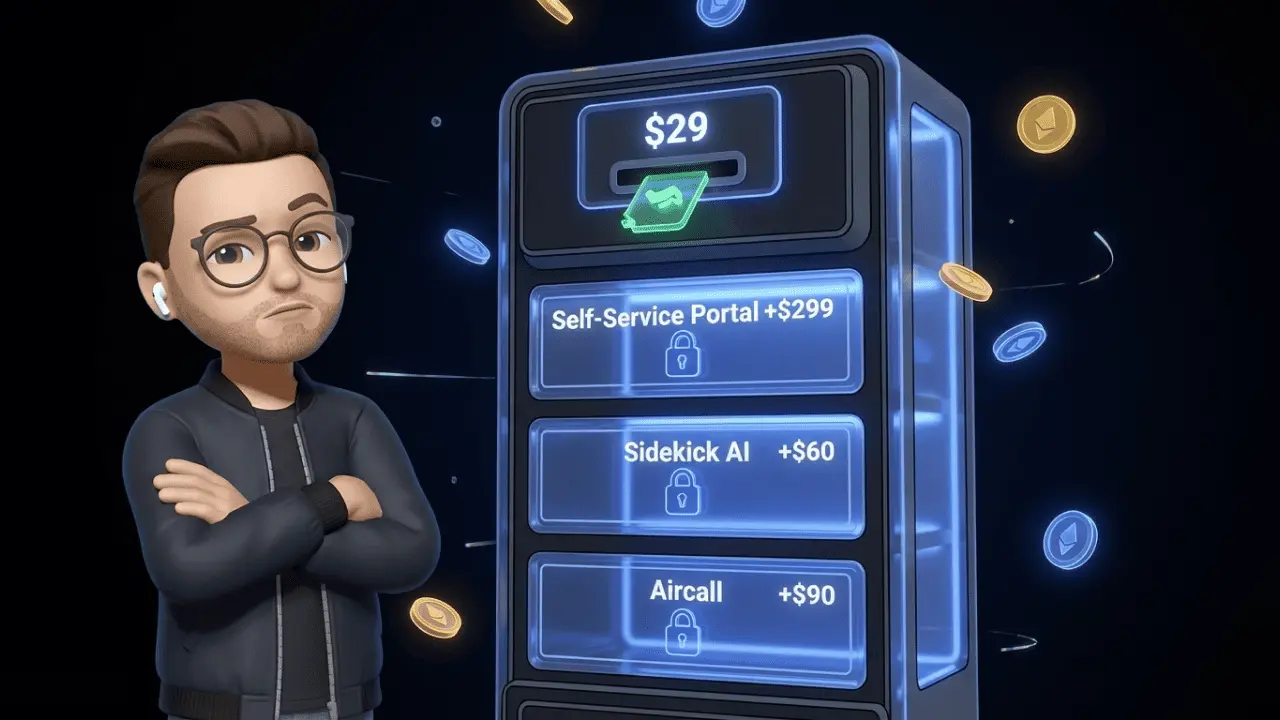
Integration depth. This is where it gets interesting for a store. Per the pricing page, native connections to CRM, booking systems, and API only come with the Enterprise plan, so from 2,000 call minutes a month. On Flex you get the basics: knowledge base, call forwarding, requests, call notes. If you want to connect your shop system without hitting Enterprise volume, you're often left with middleware like Zapier or Make. That's extra tool cost plus setup time.
More than the included phone numbers (2 on Flex, 5 on Enterprise) costs extra, say for multiple locations or languages. Ask about it directly in the sales call.
Insider tip: push down your forwarding rate
Your forwarding rate is your biggest cost lever. Two steps that work in practice:
- Prompt review every two weeks. Which five questions trigger the most forwards? Build a clean answer into the bot for exactly those.
- Hand off with context. The agent needs to know what the call is about in the first sentence. Otherwise the customer repeats themselves, and you pay the minutes twice.
Who FlowLyne Is Built For, and Who It Isn't
Look at who FlowLyne targets and the picture gets clear. There's a dedicated „For car dealerships“ login, the demo routes to a „car dealership intro call,“ and there's a published case study with the Enders Group, a dealer group with 21 dealerships. Add a connection to workshop and DMS systems. FlowLyne is also TISAX-certified, the security standard of the automotive industry.
In other words: FlowLyne is built for call-heavy local businesses. Car dealerships, medical practices, trades, service providers with a booking calendar. For that world, it's a clean solution.
In e-commerce, the reality is different. Contact with a Shopify store rarely runs over the phone. It runs over WhatsApp, email, live chat, Instagram DMs. Asynchronous, text-based, often late at night on the couch. A phone-only tool covers a thin slice of that.
So the honest question is: do you have a real phone segment? An older audience, explanation-heavy products, after-sales on the line? Then FlowLyne can be useful. If your volume runs over text, voice-only solves the wrong problem. We looked at which AI tools actually deliver in customer service in 2026 separately.
FlowLyne Alternatives, Briefly
FlowLyne is one of several AI phone assistants in the DACH region. fonio.ai, Synthflow, and Famulor play in the same field. Per-minute prices vary widely: an it-daily vendor comparison lists €0.15 per minute for fonio.ai and €0.50 for FlowLyne (as of November 2025).
But the cheapest per-minute rate is the wrong yardstick for a store. Two things matter more: does the provider process voice data in the EU? And do you get phone and text in one place, or are you building the next silo?
Voice or Chat: Where Each Channel Is Cheaper
Every channel has its own cost logic. Voice scales linearly with minutes. A five-minute appointment booking costs you €2.50 net on FlowLyne, on every single call.
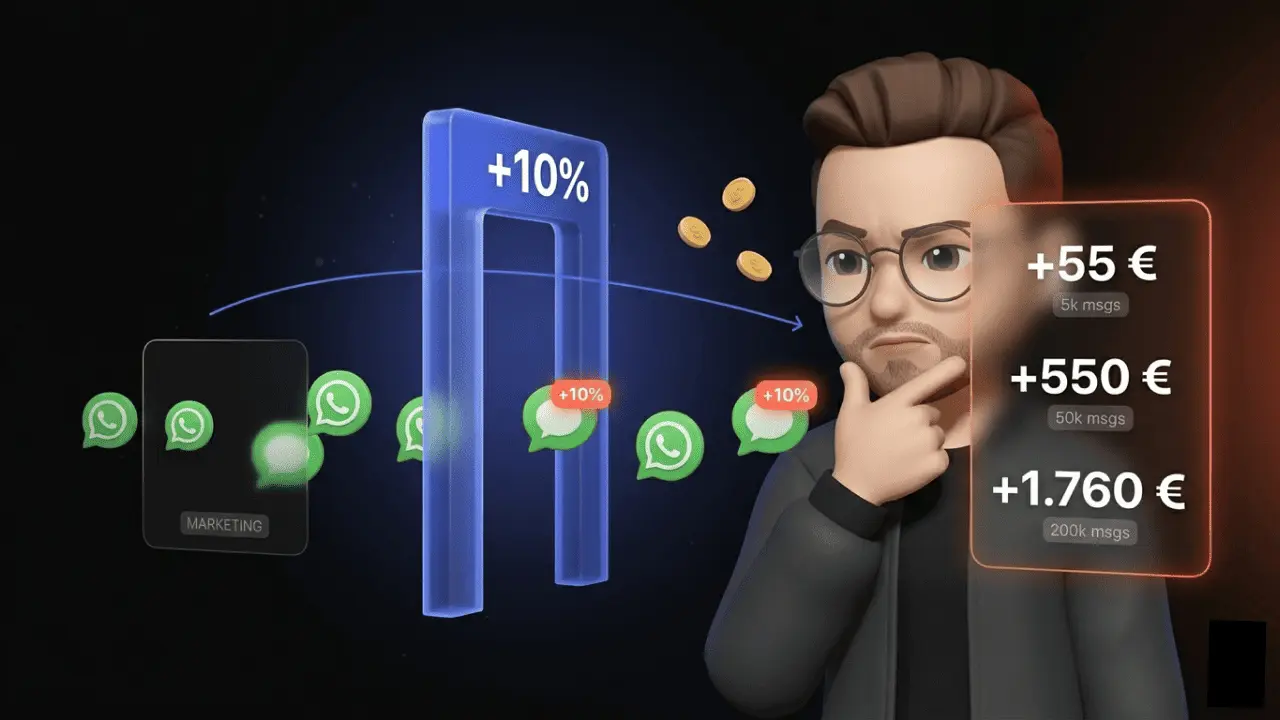
The same request over WhatsApp looks different. If the customer messages first, it runs inside the 24-hour service window and is free for you under Meta's WhatsApp pricing model. For 500 appointment bookings a month, that's the difference between €1,250 net in call minutes and near-zero Meta fees.
That doesn't mean chat always wins. An older customer who'll call anyway to ask why the new model needs different rims is better served on the phone. Complex, emotional complaints too. The channel has to fit the customer.
My take: the stronger setup is the mix. Voice for the requests that need voice. Text for the rest. Both with a shared history, so the call and the WhatsApp chat from the same person come together.
What a Store Actually Wants From a Tool Like This
Flip the question. What do you, as an online retailer, want from an AI phone assistant?
- The call knows the order. The AI sees order status and shipping details from Shopify, JTL, or Xentral before it answers.
- The call becomes a ticket, in the same history as the WhatsApp message and the email from the same customer.
- The AI acts instead of just informing. Read out order status, kick off a return, hand sensitive cases to a human with a transcript.
- Data protection holds up. EU hosting, clear rules for call recordings.
- Multilingual, because your store doesn't stop at the border.
That's exactly the gap a voice-only tool leaves open. It's why armincx Voice is part of the platform rather than a silo: phone, WhatsApp, email, and chat run in one dashboard, GDPR-compliant, hosted in Germany, with support in over ten languages. Over 450 e-commerce brands across the DACH region run on the platform.
GDPR, Server Location, and TISAX
With call recordings, data protection isn't a nice-to-have. Voice recordings are sensitive, and the GDPR sets a higher bar than plain text logs.
What FlowLyne can show here is solid. The provider advertises GDPR compliance, operates as SupraFlow GmbH out of Berlin, and is TISAX-certified. That's an audited security attestation, not a marketing label.
Still, with any voice tool it pays to look behind the curtain. That goes for FlowLyne as much as any competitor:
- Which sub-processors run in the background (language model, speech-to-text, voice synthesis), and where do they process the data?
- How long are call recordings stored?
- How does the tool meet the duty to disclose that your customer is talking to an AI?
One point for text: WhatsApp messages are end-to-end encrypted. Text logs are easier to anonymize and delete than audio files. If you want to play it safe, text is the simpler path.
Three Questions Before You Sign
First: how high will your forwarding rate really be? Not the best-case number from the sales call. Test it in a pilot with real requests. Every forwarded call costs you twice.
Second: is phone your only channel or one of several? If your customers only ever call, a voice-only tool is enough. The moment WhatsApp, email, and chat come in, the island becomes an operational problem: three tools, three subscriptions, three separate ticket histories.
Third: what does the tooling cost you over twelve months? Don't just count the minutes. Count the WhatsApp tool, the helpdesk, and the time your team loses when data doesn't flow between systems.
Bottom Line: A Clean Voice Tool, but Only Voice
FlowLyne does its job. Per-second billing, €0.50 net per minute, no setup, DACH hosting, TISAX. For a car dealership or a practice with lots of inbound calls, it's a solid and affordable solution.
For an online store, the per-minute rate isn't the real question. The question is whether phone is even your main channel. Most of the time it isn't on its own. Your contact runs over text, and a phone-only tool leaves exactly that part open.
If you treat voice as one channel among several, you're better off with one platform than with a silo. The bot on the phone knows the WhatsApp chats. The agent in chat sees the call transcript. One ticket, every channel, one history.
Want to run the numbers on your channel mix? Book a demo. We'll look at your setup, run through your tool stack, and show you what voice, WhatsApp, email, and chat add up to in one platform. No pitch. Just numbers.
FAQ: FlowLyne Pricing and Alternatives
What does FlowLyne cost per minute?
Per its own terms, FlowLyne costs €0.50 net per minute of active talk time and €0.10 net per minute for forwarded calls. Billing is per second.
Does FlowLyne have a monthly base fee?
No. The Flex plan comes with no base fee, no contract, and no minimum term. You pay €0.50 net per call minute, billed against prepaid credit.
Is FlowLyne free to use?
It depends. The Starter plan is free but only allows test calls with your own assistant. It won't take external customer calls, for that you need the Flex plan from €0.50 per minute.
Are there setup costs with FlowLyne?
No. FlowLyne is self-service, you set up the assistant yourself. There's no setup fee.
What does call forwarding cost on FlowLyne?
€0.10 net per minute, instead of the regular €0.50 and not on top of it. You pay the reduced rate while the human is on the call.
What does FlowLyne's Enterprise plan cost?
From €0.30 net per minute, depending on call volume. The Enterprise plan starts at 2,000 call minutes per month and includes native integrations, webhooks, and API.
How many phone numbers are included with FlowLyne?
Two on Flex, five on Enterprise. Additional numbers, say for more locations or languages, cost extra.
Is FlowLyne GDPR-compliant?
It depends. FlowLyne advertises GDPR compliance and is TISAX-certified. Which sub-processors run in the background and how long recordings are stored is worth clarifying case by case.
Who is behind FlowLyne?
FlowLyne is operated by SupraFlow GmbH, based in Berlin. It's a German provider of AI phone assistants.
Who is FlowLyne built for?
Mainly call-heavy local businesses: car dealerships, medical practices, trades, and service providers with appointment booking. Its references and integrations clearly target these sectors.
Is FlowLyne worth it for e-commerce stores?
It depends. Only if phone is a real channel in your store. If your customer contact runs over WhatsApp, email, and chat, you'll want an omnichannel platform rather than a voice-only tool.
Can FlowLyne book appointments in my calendar?
Yes. Native connections to calendar and booking systems come with the Enterprise plan. On Flex, the connection runs over middleware like Zapier or Make.
Does FlowLyne support multiple languages?
Yes. FlowLyne supports German and other common languages. Quality depends on the speech-to-text and voice synthesis providers behind it.
Is WhatsApp cheaper than an AI phone assistant?
It depends. For short standard requests inside the 24-hour service window, WhatsApp is usually cheaper. For complex or emotional conversations, voice is often the better channel.
Is there an alternative with phone and chat in one tool?
Yes. armincx by Chatarmin bundles AI phone, WhatsApp, email, and live chat in one inbox, including a shared ticket and customer history across all channels.