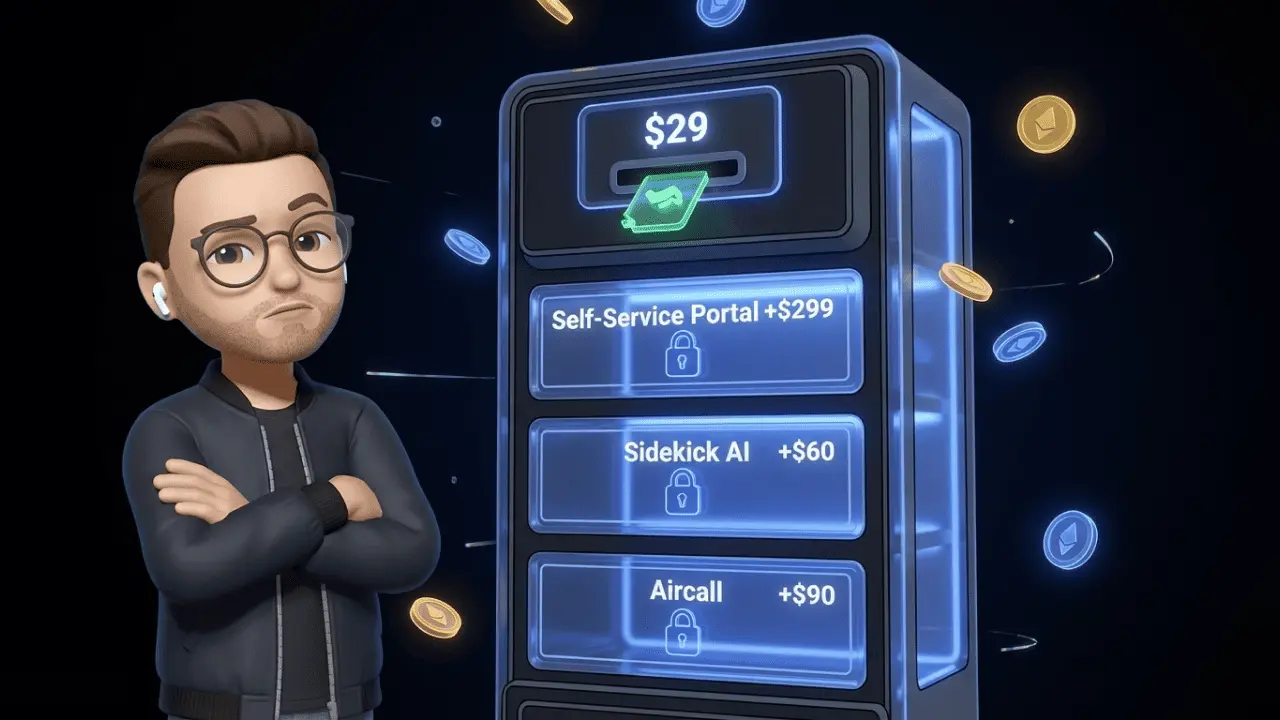

You're searching for Help Scout pricing, and you've probably already had the pricing page open. $25 per user per month. That looks manageable. The list price is only the first of two billing layers.
Help Scout charges per user, plus a fee for every AI-resolved query on top. For an e-commerce team with high ticket volume, the monthly bill comes out of exactly that combination.
This article breaks down the four plans, explains the per-resolution AI billing, and shows the add-ons that pile on in practice. Plus the question that matters for Shopify and DACH (Germany, Austria, Switzerland) shops: what a helpdesk like this does day to day, and where it hits its limits.
Help Scout pricing 2026: the four plans
Help Scout offers four plans, from a free tier up to the Pro plan. Here are the list prices per user and month.
| Plan | Price per user/month | Users | Inboxes | Docs sites |
|---|---|---|---|---|
| Free | $0 | up to 5 | 1 | 1 |
| Standard | $25 (approx. €22) | up to 25 | 2 | 2 |
| Plus | $45 (approx. €39) | up to 50 | 5 | 3 |
| Pro | $75 (approx. €65) | from 10 (minimum) | 10 | 5 |
Two notes on this. Help Scout bills in US dollars. The euro figures are rough guides at around €0.87 per dollar (June 2026) and move with the exchange rate and card fees.
The table shows the monthly list prices. On annual billing, Help Scout takes 16 % off, according to its own pricing page. You can see the exact monthly-versus-annual split by toggling directly on the Help Scout pricing page.
There's more than a couple of inboxes between Standard and Plus. WhatsApp as a channel only arrives on Plus, and so do the AI features AI Drafts and AI Summarize. Salesforce, HubSpot, and Jira are Plus and up as well, along with extended reporting. In other words: the entry point is cheap. The plan a growing team ends up needing usually costs twice as much.
The second billing layer: AI Answers per resolution
AI Answers is Help Scout's AI chatbot. It answers queries from your knowledge base and your website through a widget called Beacon. Billing runs per resolution.
A resolution is an AI session that gets solved without human help. The customer gets an answer and doesn't follow up. You're charged at most once per session. If the customer escalates to a human, no fee applies.
The price: $0.75 per resolution. New accounts get 3 months of unlimited resolutions free, after which paid plans are charged, billed in arrears the following month. Help Scout confirms this in its own AI resolution billing docs.
What that looks like in numbers:
- 300 resolutions per month: $225
- 500 resolutions per month: $375
- 1,000 resolutions per month: $750
This matters for a shop because 30 to 80 % of ticket volume is standard questions: "Where's my order," return status, and invoice copies. A knowledge-base bot handles exactly those well, and that's exactly where the AI bill scales with volume.
A spending cap protects you from surprises. Once you hit the limit, AI Answers switches off for the rest of the month, and the customer sees a message that the AI is currently unavailable.
My take: Per-resolution billing is fair as long as your volume is predictable. During the holiday season, it rarely is. If you're leaning on AI agents here, know up front how the cost behaves at peak.
Add-ons and line items that aren't on the pricing page
The plan prices are one half. The other half is add-ons that show up depending on your setup.
- Extra inbox: $10 per month on annual billing, $12 on monthly. The Standard plan includes 2.
- Extra Docs site: $20 per month ($24 monthly). Need a second knowledge base, say for another brand or language, and it costs extra.
- Onboarding: The Pro plan includes an onboarding specialist. On Standard and Plus it's an optional line item, and Help Scout doesn't publish the price. Third-party overviews put onboarding costs in the range of roughly $1,500 to $5,000.
For an e-commerce team, the inbox limit is the big one. Separate inboxes for returns, orders, and general inquiries are normal in shop operations. With two inboxes on Standard, you're over the limit fast. If you want to automate returns, you run returns as their own track anyway and need the separation.
Real cost example: a 10-person e-commerce team
A calculation for a typical DACH setup: 10 support agents, Plus plan, two extra inboxes, and AI Answers in moderate use.
| Line item | Cost per month |
|---|---|
| 10 users × $45 (Plus, monthly) | $450 (approx. €392) |
| 2 extra inboxes × $12 (monthly) | $24 (approx. €21) |
| ~300 AI resolutions × $0.75 | $225 (approx. €196) |
| Total | approx. $699/month (approx. €608) |
That's well above the $450 you had in mind from the plan price. And the calculation is conservative. No extra Docs sites, no onboarding, and none of the Q4 volume spikes.
On annual billing, the plan portion gets 16 % cheaper, and an inbox costs $10 instead of $12. The user block then drops to around $378, and the total to about $623 per month (approx. €542). The $225 for AI resolutions stays the same, because it's tied to volume, not to the billing cycle. During peak season management, the plan and the resolutions climb at the same time.
Help Scout in the e-commerce stack: strengths and limits
Help Scout is a clean, email-first helpdesk with a shared inbox, knowledge base, live chat, social channels, and AI Answers. In the market it sits between lean shared-inbox tools and heavy enterprise suites. Anyone comparing the helpdesk software landscape places Help Scout solidly in the middle.
For a Shopify or DACH shop, three questions matter.
Does the AI just answer, or does it act? AI Answers pulls answers from your knowledge base and your website. Backend actions like cancellations, address changes, or returns aren't triggered through it. It answers with text, it doesn't run processes in your shop system.
How deep do the DACH integrations go? Help Scout brings the common integrations. Deep read-and-write connections to JTL, Xentral, Shopware, or Billbee are only partly covered by many internationally built tools. When in doubt, agents keep jumping between tabs.
Where does the data sit? For a GDPR setup, EU hosting and a data processing agreement matter. AI Answers runs on OpenAI, so a US model. That belongs on the checklist before a US tool takes over support.
This is where armincx comes in, our AI customer service for e-commerce. The AI doesn't just answer queries, it executes actions in Shopify and JTL. Create a cancellation, change an address, start a return. All channels come together in one omnichannel inbox, from email to WhatsApp to Instagram. Realistically, teams automate 40 to 60 % of tickets after launch, with a target of 70 to 80 % after ongoing training. Over 450 brands use Chatarmin, including Zelesta, CATRICE, and Firebox.
Honest trade-off: if you run 90 % of your support over email and don't need deep shop actions, a lean helpdesk like Help Scout is enough. The moment the AI has to act inside your shop system, you need a different architecture.
Frequently asked questions about Help Scout pricing
Is there a free version of Help Scout?
Yes. The Free plan covers up to 5 users, 1 inbox, and 1 Docs site. The contact limit sits at 100 per month, and workflows plus most AI features are missing.
How much does Help Scout cost per month?
Help Scout costs between $25 and $75 per user and month, depending on the plan. On annual billing, Help Scout takes 16 % off. Billing is in US dollars.
How much does the AI feature AI Answers cost?
AI Answers costs $0.75 per resolved query. The first 3 months are unlimited and free for new accounts, after which paid plans are billed in arrears. You can set a monthly spending cap.
Does Help Scout support WhatsApp?
Yes, from the Plus plan. You can receive and answer inbound WhatsApp messages in the shared inbox. WhatsApp marketing, campaigns, and automations don't run through it.
Does the Help Scout AI also execute actions in the shop?
No. AI Answers answers questions from the knowledge base and the website. Processes like cancellation, address change, or return in the shop system aren't triggered by the bot itself.
How many inboxes are included in the Standard plan?
The Standard plan includes 2 inboxes. Each additional inbox costs $10 per month (on annual billing). Plus includes 5, Pro includes 10 inboxes.
How long is the Help Scout trial?
The free trial runs 15 days for Standard and Plus, no credit card. For the Pro plan, the entry point runs through the sales team. On top of that, new accounts get 3 months of free AI Answers.
Does Help Scout bill in euros or dollars?
In US dollars. Euro amounts are guides only and depend on the exchange rate and card fees.
Does Help Scout offer discounts for non-profits or startups?
Yes. Help Scout runs the "Help Scout for Good" program for qualifying non-profits and B Corps, plus its own startup plan. Whether you qualify, and on what terms, depends on the organization and the company stage.
Verdict: who Help Scout makes sense for in 2026
Help Scout fits a team of 3 to 30 people that supports primarily over email and wants a clean helpdesk. The interface is clean, the entry point cheap, and the knowledge-base AI deflection is usable.
For budgeting, the sum of both layers is what counts. The per-user plan price plus $0.75 per resolution plus add-ons for inboxes and Docs sites. Plan with the total, not the list price. Anyone shopping for a ticketing system for e-commerce should factor in next peak season's volume now.
The real fork lies elsewhere. If your AI only needs to answer, a classic helpdesk is enough. If it has to act in your shop system, cancel orders, change addresses, trigger returns, then you need an AI that connects to your stack.
See live what armincx automates in your shop: book a demo. Short conversation, no sales pressure, focused on your setup.