
You're evaluating an AI chatbot for your Shopify store and Chatbase shows up in every second tool list. Prices range from free to several thousand dollars per year. The real problem sits below the sticker price: in the credits, the add-ons, and the question of whether the tool actually covers your e-commerce use case. This article looks at Chatbase pricing 2026 through a DACH e-commerce lens. That means German, Austrian, and Swiss merchants running Shopify or ERP-driven stacks. What costs what, what you really get, and where it fits for your shop.
Chatbase Pricing 2026 at a Glance
Chatbase currently offers four public plans plus Enterprise. All prices in US dollars. Annual billing saves you 20 percent compared to monthly payment.
| Plan | Monthly | Annual | Credits/Month | Members |
|---|---|---|---|---|
| Free | $0 | $0 | 50 | 1 |
| Hobby | $40 | $32 ($384/year) | 500 | 2 |
| Standard | $150 | $120 ($1,440/year) | 4,000 | 3 |
| Pro | $500 | $400 ($4,800/year) | 15,000 | 5 |
| Enterprise | Custom | Custom | Custom | Custom |
Source: May 2026, taken directly from chatbase.co/pricing. Important to understand: These prices are just the base layer. The credit system and the add-ons often push the real monthly spend much higher. If you plan with "$40 a month" and end up on a Standard plan with auto-recharge, you can quickly pay four times that.
Free Plan: What It's Actually For
The Free plan sounds nice. You get 50 message credits per month, one AI agent, 400 KB of training data, and one workspace member.
What most reviews skip: Inactive agents on the Free plan are deleted after 14 days of inactivity. If you leave your test setup alone for two weeks, it's gone. That makes the Free plan a trial account rather than a sustainable tier. 50 credits cover a handful of test conversations. Anyone seriously trying to automate Shopify support requests can only use the Free plan as a demo. For real customer communication, you start with Hobby at the earliest.
One relevant detail: The Free plan only gives you access to "Limited Models". That means no premium models like Claude Opus 4.6 or GPT-5.2. You're testing the tool with a stripped-down model. The answer quality you see on Free differs from what you'd actually get on Standard.
Hobby Plan: 32 Dollars per Month for Solo Setups
The Hobby plan costs $32 per month on annual billing or $40 monthly. You get 500 message credits, 5 AI Actions per agent, 10 MB of training data, 2 workspace members, and access to advanced models.
Who it fits: solo founders, small shops with low ticket volume, B2B brands with manageable inboxes. A concrete calculation: 500 credits cover roughly 500 AI responses per month with standard models. A shop with 20 requests per day hits the limit after 25 days. Anyone running Claude Opus 4.6 (5 credits per response) gets only 100 responses per month on Hobby. That doesn't even last a week for active stores.
What Hobby covers: standard integrations via Zapier, basic analytics, attachments in chat. What's missing: Help Desk, Voice, Telephony, Outbound Campaigns, API access. If you're just using a chatbot as an FAQ supplement on your website, you get solid value for little money. If you want to plug the bot into a real support pipeline, you have to move up to Standard.
Standard Plan: 120 Dollars per Month as the Real Entry Point
The Standard plan ($120/Mo on annual billing, $150 monthly) is what Chatbase itself labels the "Popular" plan. You get 4,000 message credits, 8 AI Actions, 20 MB of training data, 3 workspace members.
This is where the tool gets seriously usable for shops. You get a Help Desk function, Voice and Telephony, Outbound Campaigns, API access, personalization, auto-retrain, and deeper integrations to Stripe, Zendesk, Shopify, HubSpot, Slack, WhatsApp, Messenger, and Instagram.
Reality check on the 4,000 credits: If you use Claude Opus 4.6 or Claude Opus 4.5 exclusively, those 4,000 credits shrink to 800 actual responses per month. For an active D2C shop with Black Friday bursts, that runs dry fast. You then either land on auto-recharge ($40 per 1,000 extra credits) or you upgrade to Pro. Anyone who needs more than 2 AI agents in the workspace also has to upgrade.
Pro Plan: 400 Dollars per Month for Stores with Volume
Pro costs $400 per month (annual billing) or $500 monthly. Included: 15,000 message credits, 12 AI Actions, 40 MB of training data, 5 members. Plus Advanced Analytics, Sources Suggestions, and "Tickets as a Source" for training.
When does Pro pay off? When your shop handles more than 100 conversations per day and you regularly use premium models. With standard models, 15,000 credits last comfortably for most Shopify stores. With Claude Opus 4.6, that's roughly 3,000 responses per month.
An honest observation: The jump from $120 to $400 is steep. You pay $3,360 more per year for 11,000 additional credits. That works out to $0.30 per extra credit. Auto-recharge costs just $0.04 per credit. So if you only need more volume and don't specifically need the Pro features like Advanced Analytics or "Tickets as a Source", auto-recharge is cheaper than upgrading.
Add-ons: Where the Price Quietly Climbs
The sticker prices are only half the story. Chatbase sells three add-ons that can quickly double your monthly bill.
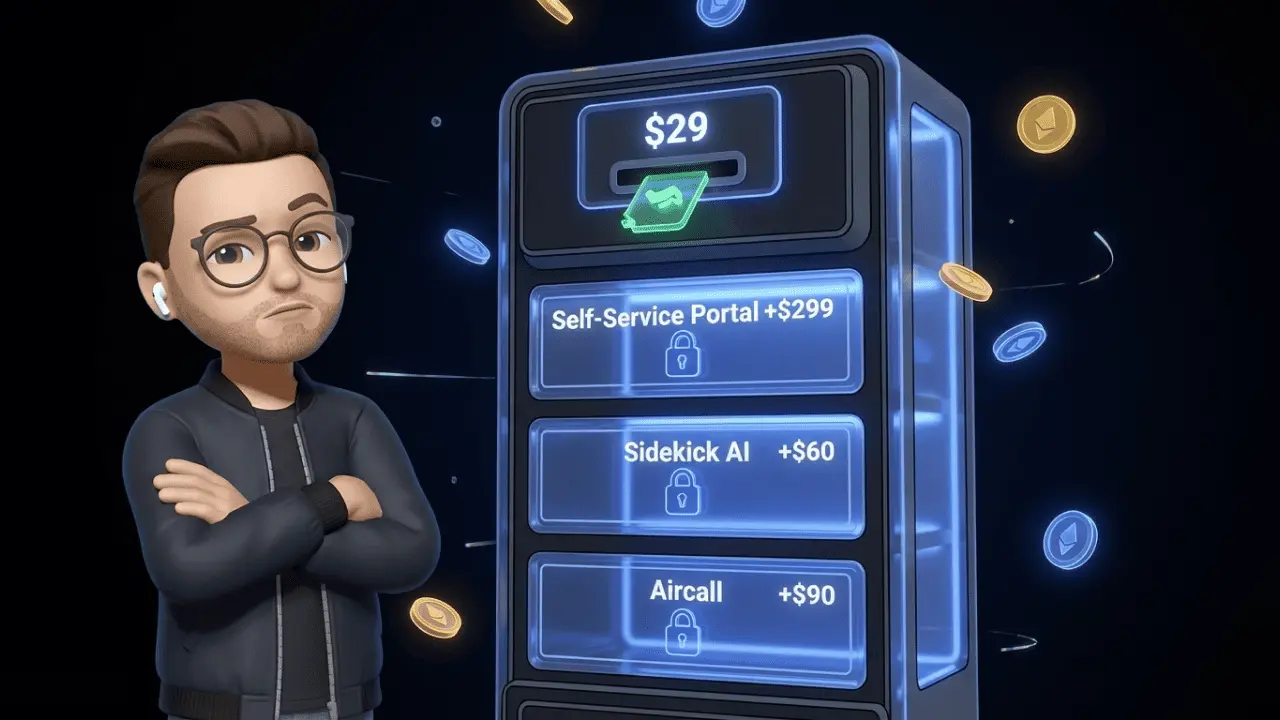
Auto-recharge credits cost $40 per 1,000 extra credits. These credits don't expire, and you can set a threshold at which Chatbase automatically tops up your account. Extra AI agents cost $300 per agent per year, which is $25 per month per agent. That matters when you run multiple bots for different brand worlds or shops. Removing the "Powered by Chatbase" badge costs $1,188 per year, or $99 per month. That is noticeably more expensive than comparable AI chatbot tools.
Concrete example: You start with Standard ($120/Mo), need your own branding ($99/Mo), and regularly buy 3,000 extra credits ($120/Mo). Effective monthly cost: $339. You're now closer in price to Pro than to Standard, without getting Pro's features. At this point, Pro is the more rational choice. This exact dynamic pushes Chatbase customers into higher plans and makes the effective average price per customer higher than the marketing pricing table suggests.
The Credit System: What a Conversation Actually Costs
The most important thing about Chatbase costs is less the monthly sticker price than the credit system. Every AI response consumes credits, and consumption depends on the model you pick.
The official breakdown from Chatbase (as of May 2026): Standard models like older GPT or Gemini variants consume 1 credit per response. GPT-5.2, Gemini 2.5 Pro, and Gemini 3.1 Pro cost 2 credits. Grok 3 costs 3 credits, Grok 4 four credits. Claude Sonnet 4.5 and 4.6 burn 3 credits per response, Claude Opus 4.5 and 4.6 five credits.
What this means in practice: If you use Claude Opus 4.6 exclusively on Standard ($120/Mo), 4,000 credits give you 800 responses per month. With standard models, it's 4,000 responses. The output difference is fivefold, the price difference zero. Anyone going for maximum quality effectively pays five times per response. Cost planning becomes much harder than with tools that use flat-rate pricing. You can counter this by routing simple requests to cheaper models and only handling complex cases with premium models. But you have to configure and monitor that yourself.
Chatbase for Shopify: What Works, What Doesn't
Chatbase has had an official Shopify app in the App Store since January 2026. The integration covers product search, order tracking, cart management, and account updates. The installation runs entirely through the app, with no code work in your Shopify theme. In the Shopify reviews, users report quick setup and good coverage of standard inquiries like WISMO ("Where is my order?"), sizing advice, and product recommendations.
What Chatbase currently doesn't cover: deep workflow automation in the DACH stack. There's no native integration to JTL, Xentral, Billbee, Shopware, or Plentymarkets. Anyone working in DACH e-commerce with German ERP or logistics systems has to use Zapier or custom API calls. That's doable, but it costs developer time and makes the bot maintenance-heavy whenever the backend changes.
Marketplace integrations for Amazon Seller Central and eBay are also missing. The problem runs through many AI chatbot tools, but for German merchants who get most of their tickets from marketplaces, it's a real deal-breaker. At armincx we take a different approach here, with native connections to JTL, Xentral, Billbee, Shopware, and Shopify, because those are the systems the over 450 brands in our network actually use.
DACH Reality: Hosting, Support, GDPR
Three points where e-commerce brands from Germany, Austria, and Switzerland should look more closely.
For hosting, Chatbase mentions AWS servers with SOC 2 compliance in its own documentation and states that data processing follows GDPR. A dedicated EU or DE hosting region for standard plans is not openly advertised on the website. Chatbase, Inc. is headquartered in San Francisco. Anyone in regulated verticals (medical, financial) or with strict DPA requirements should clarify the individual setup before signing a contract.
On support, OMR Reviews, the leading German B2B software review platform, shows zero German user reviews for Chatbase as of May 2026. The platform also lists "No information" under "German-speaking support". Official Chatbase support runs through English-language tickets. Anyone who wants a German-speaking customer success manager building workflows and guiding the onboarding will not find that here.
On reviews: On G2, Chatbase scores 4.7 out of 5 stars, based on just 14 reviews. The small sample size makes the number weakly meaningful. The negative reviews that do exist primarily flag hallucinations and rising costs through add-ons as the main complaints.
Verdict: When Chatbase Pays Off, When It Doesn't
Chatbase is a solid tool for a specific audience. Solo founders or small teams that need an AI chatbot quickly, that work on an English-language US stack, and that just need a Shopify FAQ bot get a setup for $32 to $120 per month that runs in a few steps. The Shopify app is solid, the model selection is decent, and the international footprint of over 10,000 customers worldwide is no coincidence.
Where Chatbase hits limits: deep DACH workflows like triggering returns through JTL, cancelling orders in Xentral, or filing complaints in Billbee. Also true omnichannel inboxes with German logic, German-speaking onboarding with workflow setup, and predictable flat-rate costs without credit roulette remain conditions Chatbase currently does not meet for DACH brands.
For e-commerce brands from the DACH region that want to seriously automate customer service, armincx is the anchor we recommend. AI-first by design, native DACH integrations, German-speaking CSM, fair pricing structure. If you want to know what your specific setup looks like and what it costs, book a 45-minute demo and we'll run the numbers with you.
FAQ: Common Questions About Chatbase Pricing
What does Chatbase cost in 2026?
Chatbase offers four public plans: Free ($0), Hobby ($32/Mo on annual billing, $40 monthly), Standard ($120/Mo on annual billing, $150 monthly), Pro ($400/Mo on annual billing, $500 monthly), plus Enterprise with custom pricing. As of May 2026, all prices in US dollars.
Is there a free version of Chatbase?
Yes. The Free plan costs 0 dollars and includes 50 message credits per month, one AI agent, 400 KB of training data, and one workspace member. Important: Inactive agents are automatically deleted after 14 days. The Free plan is primarily a trial, less suited for ongoing production use.
How does the Chatbase credit system work?
Every AI response consumes message credits. Consumption depends on the chosen model. Standard models use 1 credit per response, GPT-5.2 and Gemini 2.5/3.1 Pro use 2 credits, Claude Sonnet 4.5/4.6 and Grok 3 use 3 credits each, Grok 4 uses 4 credits, and Claude Opus 4.5/4.6 use 5 credits. Credits reset monthly on the 1st.
What is the difference between Standard and Pro?
Standard ($120/Mo annual billing) offers 4,000 credits, 8 AI Actions per agent, 20 MB of training data, and 3 members. Pro ($400/Mo annual billing) offers 15,000 credits, 12 AI Actions, 40 MB of training data, and 5 members. Pro also includes Advanced Analytics, Sources Suggestions, and the option to use past tickets as a training source.
Is Chatbase GDPR-compliant?
Chatbase states GDPR-compliant data processing, SOC 2 compliance, and AWS infrastructure in its own documentation. A dedicated EU or Germany hosting region for standard plans is not publicly advertised. Chatbase, Inc. is headquartered in San Francisco. Anyone with strict GDPR requirements or sector-specific rules should review the individual setup before signing.
Does Chatbase offer German-speaking support?
According to OMR Reviews (as of May 2026), no information about German-speaking support is on file. Official Chatbase support runs through English-language tickets. Chatbase currently does not offer a dedicated German-speaking customer success manager.
Does Chatbase work with Shopify?
Yes. Chatbase has had an official app in the Shopify App Store since January 2026. The integration covers product search, order tracking, cart management, and account updates. Installation runs automatically through the app, with no code work in your Shopify theme.
Can Chatbase handle returns or cancellations automatically?
On Standard and Pro plans, you can configure AI Actions that execute simple backend operations. Native workflow automation for DACH-specific return processes, for example through JTL, Xentral, Billbee, or 8returns, is not currently offered by Chatbase. Such integrations have to be built via Zapier or custom API calls and require developer time.
How many conversations fit into the Hobby plan?
Hobby includes 500 message credits per month. With standard models, that's roughly 500 AI responses. Anyone using Claude Opus 4.6 (5 credits per response) gets 100 responses per month. For a shop with 20 inquiries per day, the Hobby plan lasts only 5 days if premium models are active.
How much do extra credits cost at Chatbase?
Extra credits are available as an auto-recharge add-on for $40 per 1,000 credits. These credits don't expire. You can set a threshold at which Chatbase automatically tops up the balance to avoid service interruptions.
How much does the Chatbase white-label option cost?
Removing the "Powered by Chatbase" badge costs $1,188 per year, or effectively $99 per month. That makes the option almost as expensive as a complete Standard plan and noticeably pricier than comparable AI chatbot tools.
Is annual billing on Chatbase worth it?
Annual billing saves 20 percent compared to monthly payment. On the Standard plan, that's $360 in annual savings, on Pro it's $1,200. Anyone using Chatbase for at least 10 months comes out ahead with annual billing. Before committing, it's worth testing with monthly billing to confirm the tool fits your use case.
What is the best Chatbase alternative for DACH e-commerce?
For shops with a DACH focus, a solution with native integrations to JTL, Xentral, Billbee, and Shopware plus German-speaking support is often the better choice. armincx covers these requirements. melibo and mateo are also from the DACH region and frequently evaluated in similar setups.