
Quick Verdict: Melibo in Three Sentences
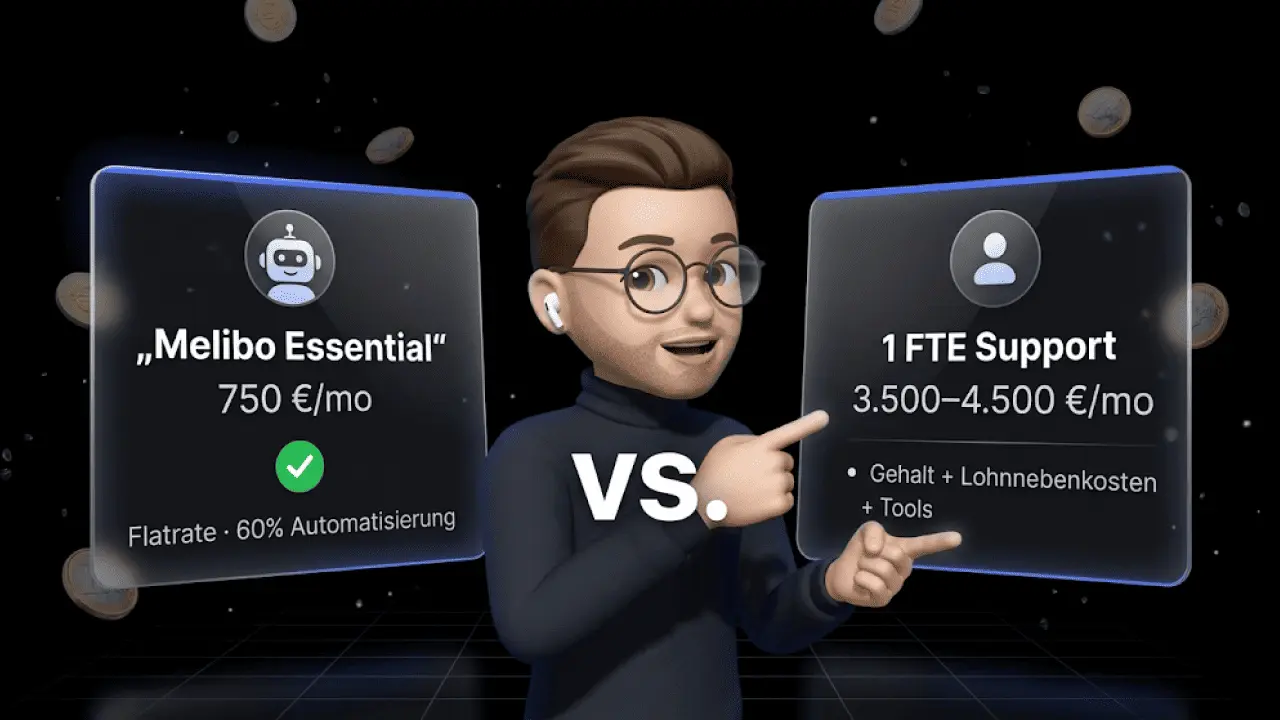
€750/month (~$815) for an AI chatbot that, according to customer reports, automates 40 to 60% of support tickets — that's cheaper than half a customer service hire. The flat-rate model gives you cost control during peak seasons. But: no public pricing, a notable price hike on the Professional tier, and a clear focus on reactive support — if you need proactive marketing or WhatsApp campaigns, you'll need to look elsewhere.
Flat Rate vs. Pay-Per-Ticket: Why the Billing Model Makes the Difference
Melibo doesn't charge per conversation or per ticket. Instead: unlimited requests across all plans. Whether your bot handles 500 chats in January or 15,000 on Black Friday — the monthly price stays the same.
Sounds like a detail. In day-to-day e-commerce, it's a decisive factor.
Many chatbot and helpdesk providers use volume-based pricing. Here's what that looks like in practice:
| Billing Model | Quiet Month (500 Tickets) | Peak Season (5,000 Tickets) |
|---|---|---|
| Pay-per-ticket (€0.50/ticket) | €250 variable + base fee | €2,500 variable + base fee |
| Melibo Flat Rate (Essential) | €750 fixed | €750 fixed |
Fahrrad XXL switched to Melibo for exactly this reason: they wanted to prepare their customer service for peak season without costs scaling with volume.
The flip side: you pay the full price even during quiet months. If your chatbot only handles 200 inquiries in summer, you still pay at least €750 (~$815). For businesses with consistently low inquiry volume, a pay-per-use model might be cheaper.
The Four Melibo Plans in Detail
Melibo stopped publishing prices publicly in 2025. Through review platforms like OMR Reviews, trusted.de, and Capterra, the tiers can be reconstructed. As of early 2026:
Essential — From €750/Month (~$815)
Up to 3 users, one integration, unlimited requests.
The entry point for small teams with a clear FAQ focus and a single channel — typically website chat. Personal German-speaking support is included, along with the initial bot setup by Melibo's experts.
The catch: one integration means one. Shopify or Zendesk — not Shopify and Zendesk. If you need both, you'll have to upgrade.
Professional — From €1,750/Month (~$1,900)
Up to 10 users, three integrations, 100 workflows, multichannel support.
Important: Older sources still list this tier at €1,250. The price increase to roughly €1,750 represents a 40% jump. Anyone relying on outdated comparisons is calculating with wrong numbers.
Once you need multichannel — website plus WhatsApp plus helpdesk integration — you land here. €1,750 per month is €21,000 per year. That's a budget that needs internal justification.
Premium — From €2,500/Month (~$2,720)
Up to 20 users, five integrations, unlimited workflows, full feature set.
For mid-sized e-commerce teams running multiple channels and integrations in parallel. Five integrations sound like a lot — in e-commerce reality (Shopify, Klaviyo, Zendesk, ERP, logistics), you're still at the limit.
Enterprise — On Request
Custom user count, custom integrations, dedicated SLAs, dedicated account manager. Melibo negotiates individually here.
The 2025 Price Increase: What Changed
A detail missing from most comparison articles: the Professional tier was raised from €1,250 to roughly €1,750 in 2025.
That's €500 more per month or €6,000 more per year.
For existing customers, this can be a shock — especially if the contract is up for renewal during this period. For new customers evaluating options, the new number is the only relevant one. Don't rely on price comparisons researched before 2025.
Setup Fee and Onboarding
On top of the monthly subscription, Melibo charges a one-time setup fee. The exact amount isn't publicly disclosed — it depends on project scope.
What you get for it: Melibo crawls your existing FAQ pages, builds the Knowledge Hub, creates the initial intents, and trains the bot on your typical customer inquiries. The average time-to-go-live is 20 business days — roughly four weeks from contract signing to a live bot. This figure is based on over 80 completed customer projects.
Combined with the first monthly fee, you're quickly looking at a mid-four-figure amount before the bot has answered a single inquiry. For bootstrapped companies or small shops on a tight budget, that's a real barrier.
On the positive side: Melibo offers an AI Agent Guarantee during the first months. You can test and measure the bot's value before committing long-term.
Features That Justify the Price — and the Limits
Ticket automation in the helpdesk. Melibo can automatically categorize email inquiries in Zendesk or Freshdesk, route them, and create AI-powered draft responses. This saves time not just in chat, but also in email support. For shops with high email volume, that's a tangible lever.
GREYHOUND integration for marketplaces. Through the GREYHOUND connector, Melibo automates inquiries from Amazon, eBay, and Otto — not just your own shop, but also your marketplace communication. For multichannel retailers in the DACH region, this is a concrete advantage that most competitors don't offer.
GenAI and Knowledge Hub. GPT-4 generates answers from your documents, URLs, and FAQ content. Works better than classic intent-based bots — but has limits with very product-specific questions (spare part compatibility, size charts for niche products).
Bot Gym. Code-free training tool. Your team sees which questions the bot didn't understand and assigns them with a few clicks. Saves coordination with developers.
GDPR and compliance. Servers in Frankfurt am Main, ISO 27001 and ISO 9001 certified, German-speaking support. In the DACH market, that's not a nice-to-have — it's a requirement.
Where Melibo hits its limits:
Melibo focuses on reactive support. Proactive outreach — actively engaging website visitors or cart abandoners — isn't part of the product. For WhatsApp marketing (newsletters, campaigns, abandoned-cart flows), you'll need a separate tool.
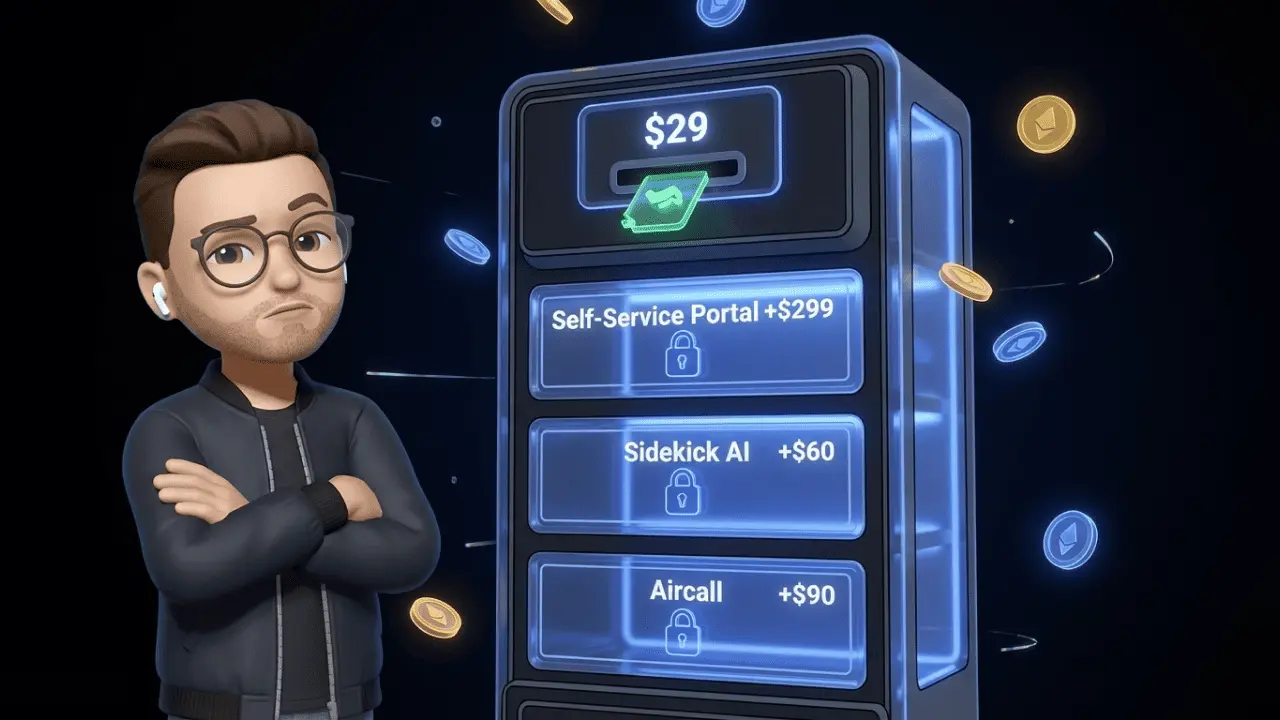
And: no self-service access. Melibo relies on a managed service approach. If you prefer configuring your bot yourself, iterating quickly, and running A/B tests, you're giving up control here.
Melibo in the Market: What Do You Get Elsewhere?
€750 entry price — is that a lot? Depends on what you compare it to.
| Criterion | Melibo (Essential) | Lime Connect + AI Add-Ons | Support Agent (Germany) |
|---|---|---|---|
| Monthly Cost | from €750 (~$815) | approx. €300–500 (~$325–545) | €3,500–4,500 (~$3,800–4,900) |
| AI Automation | Included, flat rate | Add-on, per conversation | — |
| Flat Rate on Requests | Yes | No (100 conversations for €99) | Unlimited (limited by work hours) |
| Managed Setup | Yes (bot built by Melibo) | No (self-service) | — |
| Proactive Outreach | No | Yes (proactive chat) | Yes |
The comparison with chatbot costs in general shows: the better benchmark isn't the software price, but the personnel costs. If Melibo's bot automates 40 to 60% of incoming tickets — and that's exactly what customers like Fahrrad XXL report — you're saving one to two full-time hires in the best case.
But the math only works if your ticket volume is high enough. A shop with 50 support inquiries per month doesn't need an AI agent at €750. Period.
ROI Threshold: When Does Melibo Pay Off?
The rule of thumb: From 500+ support inquiries per month and an internal cost-per-ticket above €3, the ROI calculation starts to make sense.
On OMR Reviews, Melibo holds a rating of 4.9 stars (60+ reviews), on Capterra a full 5.0. For a tool in this price range, that's remarkable. Customers report a reduction in support volume of up to 60%. babyartikel.de and travelite also use Melibo.
Melibo is less likely worth it if you have a small team with under 100 inquiries per month, need omnichannel marketing, or want to proactively engage customers. In those cases, either cheaper live chat tools with AI add-ons or all-in-one solutions covering both support and marketing are a better fit.
Bottom Line: Melibo Pricing — Reasonable, but Not for Everyone
Melibo's pricing model is justifiable for what's delivered. An AI agent from €750/month (~$815) that automates 40 to 60% of tickets is cheaper than half a customer service hire. The flat rate gives you cost control, the managed onboarding saves weeks of ramp-up time. And the ratings (4.9 on OMR, 5.0 on Capterra) show: the customers using it are satisfied.
The weaknesses need to be stated just as clearly: no public pricing transparency since 2025, a 40% increase on the Professional tier, setup fees, and a clear focus on reactive support. If you need proactive marketing, WhatsApp campaigns, or an all-in-one CX solution, Melibo isn't where you'll find it.
My recommendation: before your first call with Melibo, calculate how many tickets your team handles per month and what each ticket costs you in personnel. If the result is above €1,500/month? Then a conversation with Melibo makes sense.
And if you want to set up WhatsApp marketing alongside your support — book a demo with Chatarmin.
Frequently Asked Questions About Melibo Pricing
How much does Melibo cost per month?
The Essential tier starts at €750 (~$815) per month, the Professional tier is currently around €1,750 (~$1,900), and the Premium package sits at roughly €2,500 (~$2,720). For Enterprise customers, Melibo provides custom quotes on request.
Are there hidden costs with Melibo?
Yes — on top of the monthly subscription, there's a one-time setup fee for onboarding and the initial bot build. After that, the ongoing monthly costs are fixed, since Melibo uses a flat-rate model without per-conversation billing.
How long does it take to set up Melibo?
The average ramp-up time from contract signing to go-live is around 20 business days according to Melibo. This figure is based on experience from over 80 completed customer projects.
Is Melibo GDPR-compliant?
Yes — Melibo hosts all data on servers in Frankfurt am Main and holds both ISO 27001 and ISO 9001 certifications. For e-commerce businesses processing customer data, this is a critical compliance factor.
What integrations does Melibo offer?
Key integrations include Shopify, Shopware, Zendesk, Freshdesk, GREYHOUND (for marketplaces like Amazon, eBay, Otto), Xentral, PlentyOne, and weclapp. The number of available integrations depends on your chosen plan.
Is Melibo worth it for small shops?
For shops with fewer than 500 support inquiries per month, the fixed costs of at least €750 (~$815) plus setup fee are often hard to justify. In that case, more affordable live chat tools with optional AI add-ons are a better fit.
Can Melibo automate WhatsApp?
Yes, Melibo can connect to WhatsApp Business and answer support inquiries there automatically. For proactive WhatsApp marketing (newsletters, campaigns, abandoned-cart flows), however, you'll need a separate tool like Chatarmin.
What happens when the bot can't answer a question?
Through the human handover, the inquiry is routed to a human agent — either via integrated live chat or as a support ticket. The AI provides the agent with suggested responses to speed up resolution time.
Does Melibo offer a trial period?
There's no classic free trial. Instead, Melibo offers an "AI Agent Guarantee" during the first months, allowing you to measure the bot's value in your business before committing long-term.
What's the automation rate with Melibo?
Customers report on platforms like OMR Reviews and Capterra that Melibo's AI Agents reduce support volume by up to 60%. The actual rate depends on the quality of training data and the type of inquiries.
What languages does the Melibo chatbot support?
Melibo is multilingual and can automatically translate and respond to customer inquiries in over 100 languages. The number of included languages depends on your plan — the Essential tier typically includes two, the Professional tier five.
Can Melibo automate emails too?
Yes — through the Ticket Automation feature, Melibo can automatically categorize email inquiries in your helpdesk system (e.g., Zendesk or Freshdesk), route them to the right agent, and create AI-powered draft responses.
How does the Melibo bot learn?
Through the Knowledge Hub, you feed the bot with existing FAQs, website URLs, or PDF documents. The generative AI (GPT-4) formulates answers from this content, which you can then retrain and improve in the Bot Gym without any coding skills.
Is there a minimum contract term with Melibo?
Since Melibo is an enterprise-focused SaaS product with custom onboarding and a setup fee, annual contracts are standard. This aligns with planning needs in e-commerce, where you especially want to plan ahead for peak seasons like the holiday shopping period.